 BTC
BTC  ETH
ETH  XRP
XRP SOL
SOL  DOGE
DOGE On Thursday, September 24, the average 30-year fixed mortgage rate hit 7.45% on Mortgage News Daily’s daily survey — after jumping 19 basis points in a single afternoon (from 7.26% that morning). That is roughly a two-year high, last seen near the late-2023 peak of 7.79%.
Bankrate’s national average sits at 7.33% today. Freddie Mac’s weekly survey reads 7.03% — its first print above 7% since January 2025. The Mortgage Bankers Association puts its contract rate at 7.12%, the highest since May 2024.
If you are a first-time buyer, this is not the moment to wing it. At these rates, a single bad mortgage decision can quietly cost you tens of thousands of dollars over the life of the loan. Here is the survival guide.
Why rates are spiking
Three forces, all verified this month:
- The Fed hiked on September 16 — its first rate increase in three years — lifting the federal funds range to 3.75–4.00% to fight stubborn inflation.
- The 10-year Treasury yield crossed 5% on September 23 (up from ~4% earlier this year). Mortgage rates track this yield, not the Fed’s rate directly.
- Inflation is stuck at 3.4% (September 11 report), well above the Fed’s 2% target, with oil above $100 a barrel adding pressure.
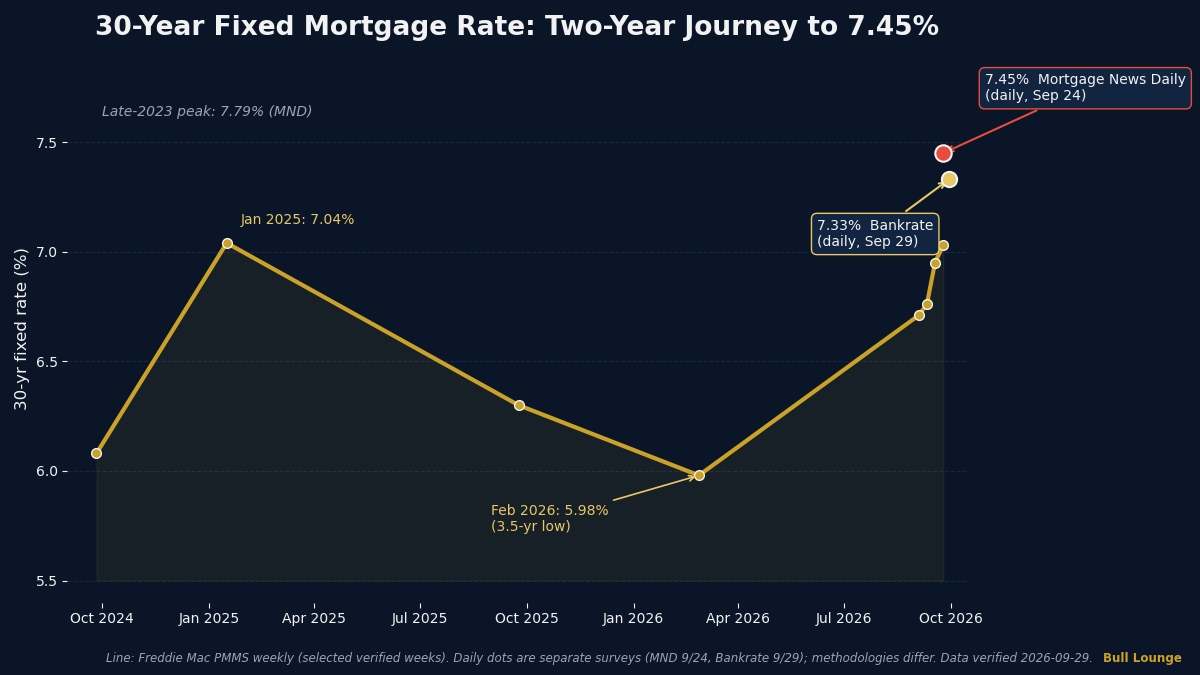
The market impact is already visible: Redfin reports the median monthly mortgage payment hit $2,633 (up 3.4% year over year), while pending home sales fell 5.4% to their lowest level in roughly three years.
What 7.45% actually costs you
Same $400,000 loan, 30-year fixed, principal & interest:
| Rate | Monthly payment | Lifetime interest |
|---|---|---|
| 6.50% | $2,528 | $510,178 |
| 7.00% | $2,661 | $558,036 |
| 7.45% | $2,783 | $601,943 |
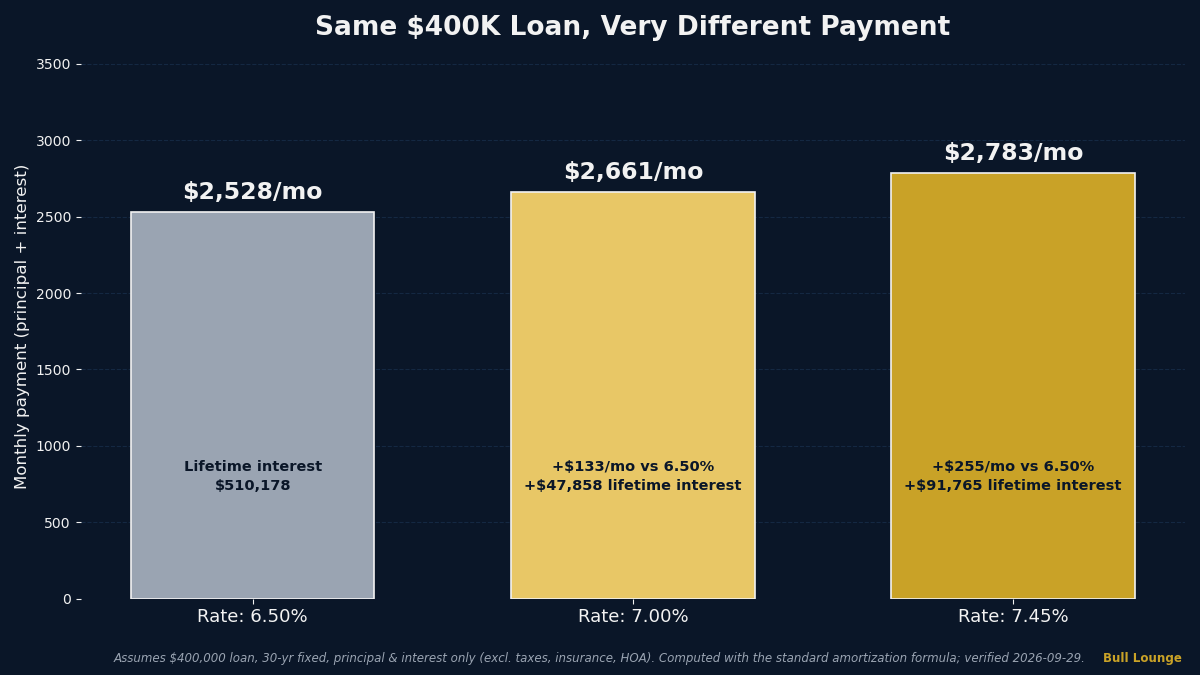
That is +$255/month and +$91,765 in lifetime interest versus 6.50% — for the exact same house. (Math: standard amortization formula. Assumes 30-yr fixed, P&I only — taxes, insurance, and HOA not included.)
The 8-move survival checklist
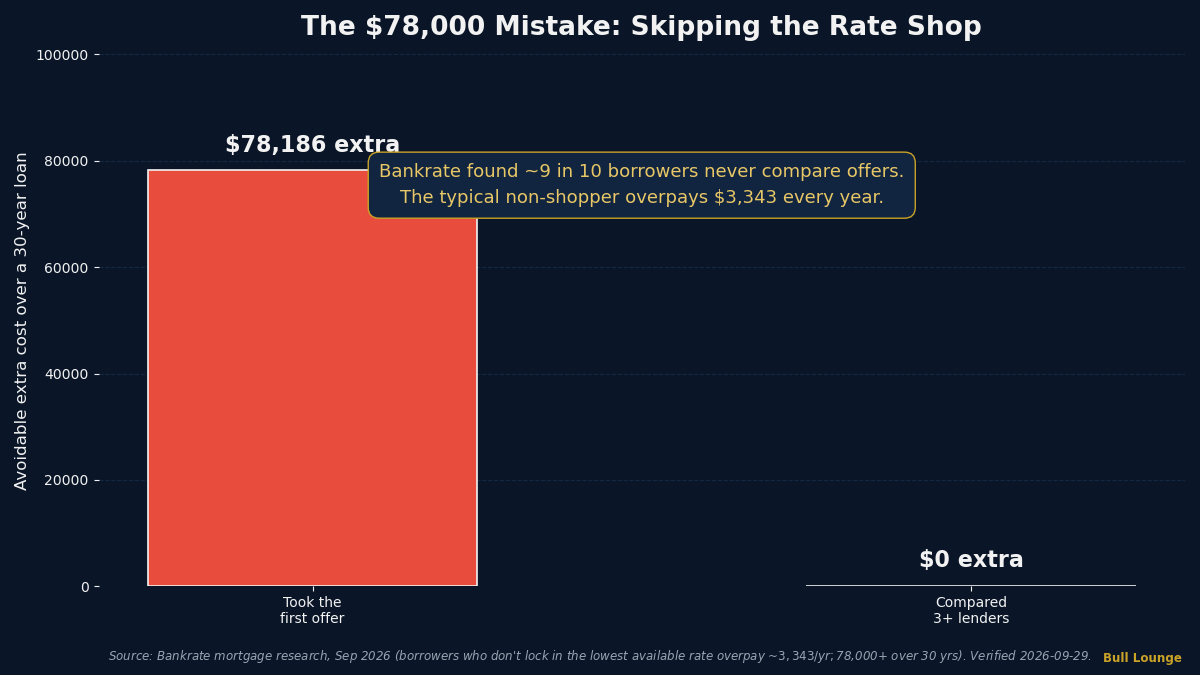
1. Get 3–5 quotes on the SAME day. Bankrate research found ~9 in 10 borrowers never compare offers — and the typical non-shopper overpays $3,343 a year, or $78,000+ over a 30-year loan. Rates move intraday now (remember: 19 bps in one afternoon). Same-day quotes are the only apples-to-apples comparison.
2. Compare APRs and Loan Estimates, not headline rates. A 7.25% quote with $8,000 in lender fees can be worse than 7.45% with $1,500 in fees. By law, lenders must give you a standardized Loan Estimate within 3 business days of application — line them up side by side.
3. Set your walk-away rate BEFORE you tour homes. Decide the maximum monthly payment your budget survives (most advisors cap housing at ~28% of gross income) and the rate above which you walk away. Emotional bidding at 7.45% is how buyers end up house-poor.
4. Lock strategically. If you are closing within 30 days, lock now — volatility is one-directional at the moment. Closing in 45–60+ days? Ask about a float-down option (locks your rate but lets you capture a drop, usually for a fee). Never pay for an extended lock you don’t need.
5. Do the points math honestly. Buying discount points (prepaid interest to lower your rate) only pays off if you keep the loan past the breakeven point — typically 5–7 years. Divide the points cost by the monthly savings; if the answer exceeds how long you will realistically hold the loan, skip them.
6. Get underwritten at 7.50%, not at today’s quote. Ask your lender to qualify you at a stress-test rate slightly above current quotes. If your debt-to-income ratio only works at 7.0% and rates hit 7.6% before closing, your approval can evaporate — along with your earnest money.
7. Negotiate seller concessions and buydowns. In a cooling market (pending sales at 3-year lows), sellers are more flexible. A 2-1 buydown (rate reduced 2% in year one, 1% in year two, paid by the seller) or closing-cost credits can beat a price cut dollar-for-dollar at these rates. Ask your agent what is closing in your zip code.
8. Don’t drain your emergency fund chasing 20% down. PMI on a 10%-down loan often costs less than the risk of entering homeownership with zero cash buffer — especially with job-market uncertainty. Run both scenarios with your lender.
What NOT to do
- Don’t panic-buy. “Rates might hit 8%” is not a financial plan. An overpriced house at 7.45% is worse than a fairly-priced one at 7.6%.
- Don’t grab an ARM blindly. ARM share just jumped to 9.8% of applications (5/1 ARMs averaging 6.10%, per MBA) — but that discount can reset higher. Only consider one if you have a concrete, dated exit plan (sale or refinance) before the fixed period ends.
- Don’t let the rate distract you from the price. At 7.45%, every $10,000 of purchase price costs you ~$70/month. Negotiating the price down is often more powerful than hunting for an extra 0.125% on the rate.
Bottom line
You can’t control the 10-year Treasury. You CAN control how many lenders compete for your loan, what you pay in fees, and the price you agree to. In a 7.45% market, the shopping — not the timing — is the edge.
Coming every Monday on Bull Lounge: the Mortgage Rate Check — this week’s rates across MND, Bankrate, Freddie Mac, and MBA, what moved them, and what it means for your buying math.
Not financial advice. This is educational content based on publicly reported rate surveys; your actual rate depends on credit, down payment, loan type, and lender. Talk to a licensed mortgage professional about your situation.
Sources
- Mortgage News Daily daily survey via BigGo Finance — 30-yr fixed 7.45% on Sep 24, 2026 (19-bp single-day jump); 7.49% on Sep 25; late-2023 peak ~7.8%
- WSJ / Bankrate — 30-yr fixed national average 7.33% on Sep 29, 2026
- Freddie Mac PMMS — 7.03% week ending Sep 24, 2026 (first >7% since Jan 16, 2025); 5.98% on Feb 26, 2026; 6.08% on Sep 26, 2024
- MBA Weekly Applications Survey (week ending Sep 18, 2026) — 30-yr contract rate 7.12%, highest since May 2024; ARM share 9.8%; 5/1 ARM 6.10%
- Bankrate mortgage research (Sep 2026) — non-shoppers overpay ~$3,343/yr; $78,000+ over 30 yrs; ~9 in 10 don’t compare
- Bankrate rate news (Sep 24, 2026) — 10-yr Treasury above 5%; inflation 3.4%; Fed hiked Sep 16 (first in 3 yrs)
- Redfin via economy.ac (Sep 2026) — median monthly payment $2,633 (+3.4% YoY); pending sales −5.4% YoY
- Payment math computed with the standard amortization formula; assumptions stated in the text
