 BTC
BTC  ETH
ETH  XRP
XRP SOL
SOL  DOGE
DOGE Choosing between a Roth IRA and a Traditional IRA is one of the highest-impact decisions an everyday investor can make, and the right answer is not the same for everyone. Both accounts shelter your investments from taxes as they grow, and both share the same annual contribution limit. The real difference is timing: do you want the tax break now, or tax-free income later?
Get this choice right and you can keep thousands of dollars that would otherwise go to taxes over a lifetime of compounding. This guide walks through how each account is taxed, the 2026 limits and income rules, and a simple framework for deciding which one fits your situation.
Roth IRA vs Traditional IRA: Side-by-Side Comparison
| Roth IRA | Traditional IRA | |
|---|---|---|
| Contributions | After-tax dollars (no deduction) | Pre-tax or tax-deductible dollars |
| Tax break timing | None today; tax-free withdrawals later | Deduction today; taxes due later |
| Withdrawals in retirement | Tax-free if qualified (59½ + 5-year rule) | Taxed as ordinary income |
| Required minimum distributions | None for the original owner | Begin at age 73 (rising to 75 under SECURE 2.0) |
| Early access to contributions | Withdraw anytime, tax- and penalty-free | Withdrawals generally taxed + 10% penalty before 59½ |
| Income limits (2026) | Phase-out: $153K–$168K single; $242K–$252K joint | No income limit to contribute; deduction phases out if covered by a workplace plan |
| 2026 contribution limit | $7,500 under age 50; $8,600 at 50+ — combined across both accounts | |
| Best for | Lower earners now, higher earners later, tax-free flexibility | Peak earners wanting a deduction now |
How Each Account Is Taxed
Roth IRA: Pay Taxes Now, Withdraw Tax-Free Later
With a Roth IRA, you contribute dollars you have already paid tax on, so there is no deduction. The payoff comes later: once you are 59½ and have held the account for at least five years, every dollar you withdraw — contributions and decades of growth alike — is completely tax-free.
Two features make the Roth unusually flexible. First, you can withdraw your contributions at any time, for any reason, with no taxes or penalties, because you already paid tax on that money. (Earnings are different: pulling those out early generally triggers taxes and a 10% penalty unless an exception applies.) Second, the original owner never faces required minimum distributions, so the account can keep compounding as long as you live.
Traditional IRA: Take the Deduction Now, Pay Taxes Later
A Traditional IRA flips the timing. Contributions are typically made with pre-tax dollars or are tax-deductible, which lowers your taxable income in the year you contribute. Investments then grow tax-deferred until you withdraw them.
There are two catches worth understanding. First, if you or your spouse is covered by a retirement plan at work, your ability to deduct the contribution phases out above certain income thresholds, so high earners with a 401(k) may get little or no deduction. Second, withdrawals in retirement are taxed as ordinary income, and required minimum distributions currently begin at age 73, rising to 75 under SECURE 2.0 — the IRS forces you to start drawing the account down whether you need the money or not.
2026 Contribution Limits and Income Phase-Outs
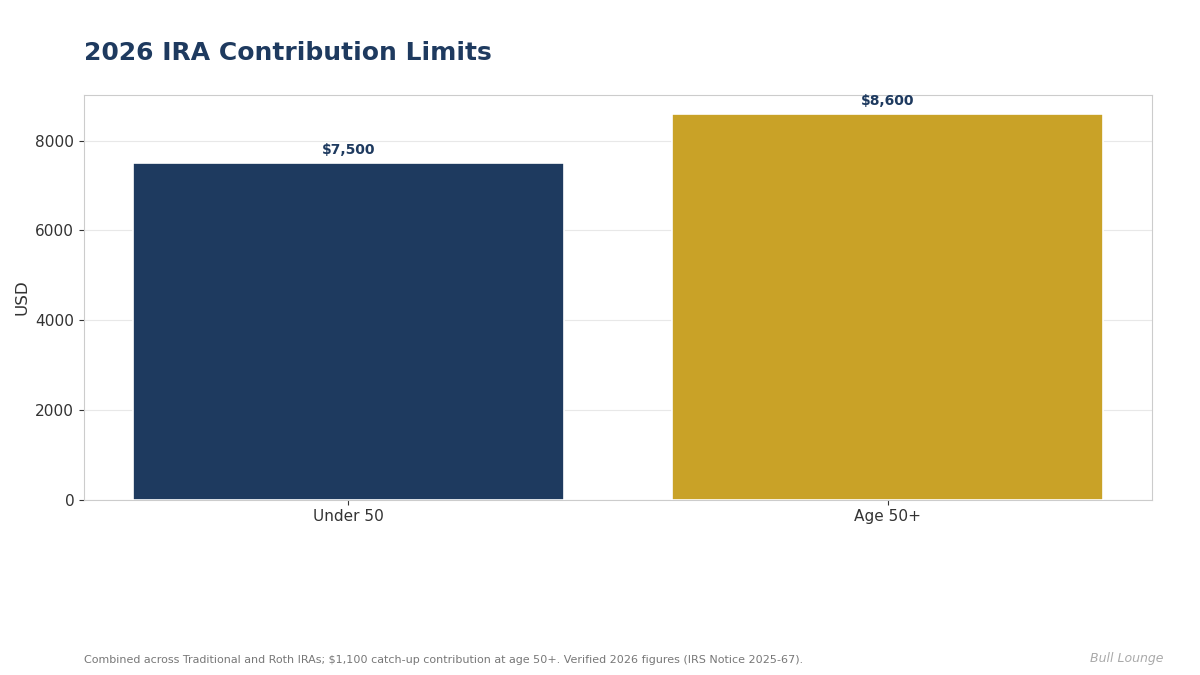
For 2026, you can contribute $7,500 to your IRAs if you are under 50, or $8,600 if you are 50 or older thanks to the $1,100 catch-up contribution. That limit is combined across your Traditional and Roth IRAs — for example, you could put $4,000 in a Roth and $3,500 in a Traditional, but your total cannot exceed the cap.
Anyone can contribute to a Traditional IRA regardless of income, though deductibility may be limited as noted above. Direct Roth IRA contributions are subject to income phase-outs based on modified adjusted gross income (MAGI) for 2026:
- Single or Head of Household: phase-out from $153,000 to $168,000
- Married Filing Jointly: phase-out from $242,000 to $252,000
- Married Filing Separately (and lived with spouse): phase-out from $0 to $10,000
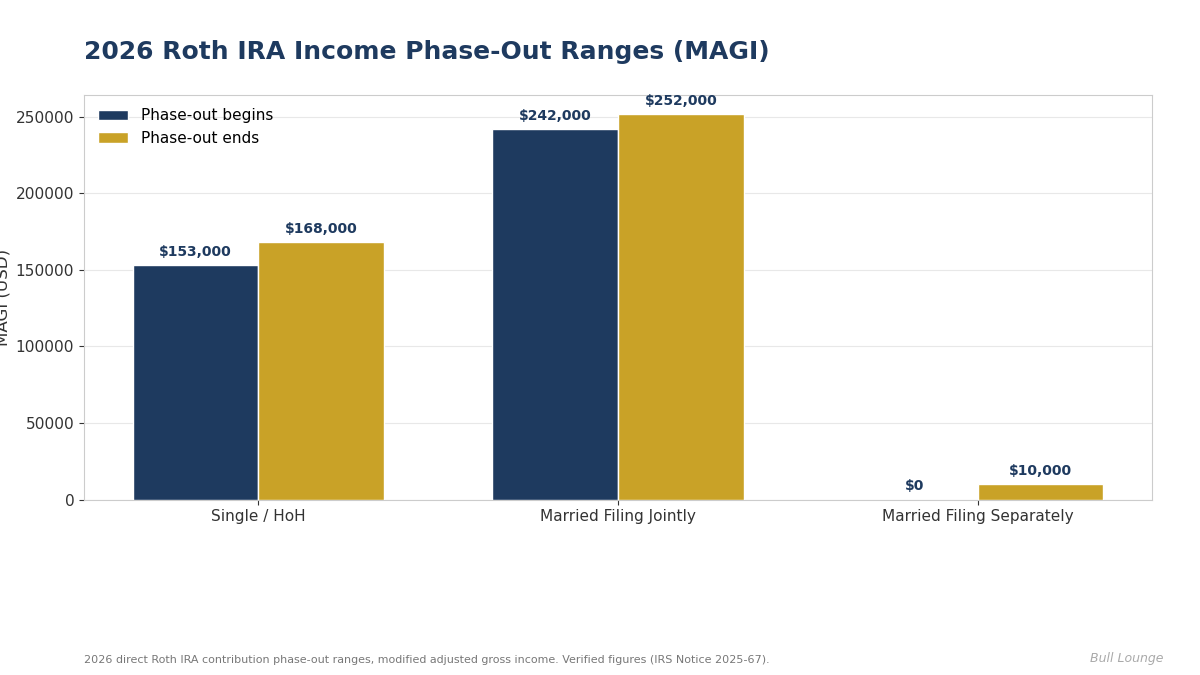
Earn above the top of your range and you cannot contribute directly to a Roth IRA at all — but as covered below, high earners still have a legal workaround.
When the Roth IRA Wins
The Roth tends to win when your tax rate today is lower than what you expect in retirement. That describes a lot of everyday investors:
- You are early in your career. If you are in the 12% or 22% bracket now but expect to earn more later, paying tax at today’s lower rate and withdrawing tax-free later is the better trade.
- You want flexibility. The ability to pull contributions out penalty-free makes the Roth double as a backup emergency layer, and the absence of RMDs means you are never forced to withdraw on the IRS’s schedule.
- You expect higher taxes in the future. Nobody knows future tax rates, but if you believe rates will rise, locking in today’s rates with a Roth is a reasonable hedge.
When the Traditional IRA Wins
The Traditional IRA tends to win when your tax rate today is higher than what you expect in retirement:
- You are in your peak earning years. If you are in the 32% or higher bracket now and expect to drop to a lower bracket in retirement, the upfront deduction is worth more than tax-free withdrawals later.
- You need the tax break this year. A deductible contribution directly reduces this year’s tax bill, which can matter for cash flow or for staying under thresholds tied to adjusted gross income.
- You expect a lower income in retirement. Most retirees spend less than they earned while working. If that describes your plan, deferring taxes until withdrawals often wins on pure math.
A Simple Decision Framework
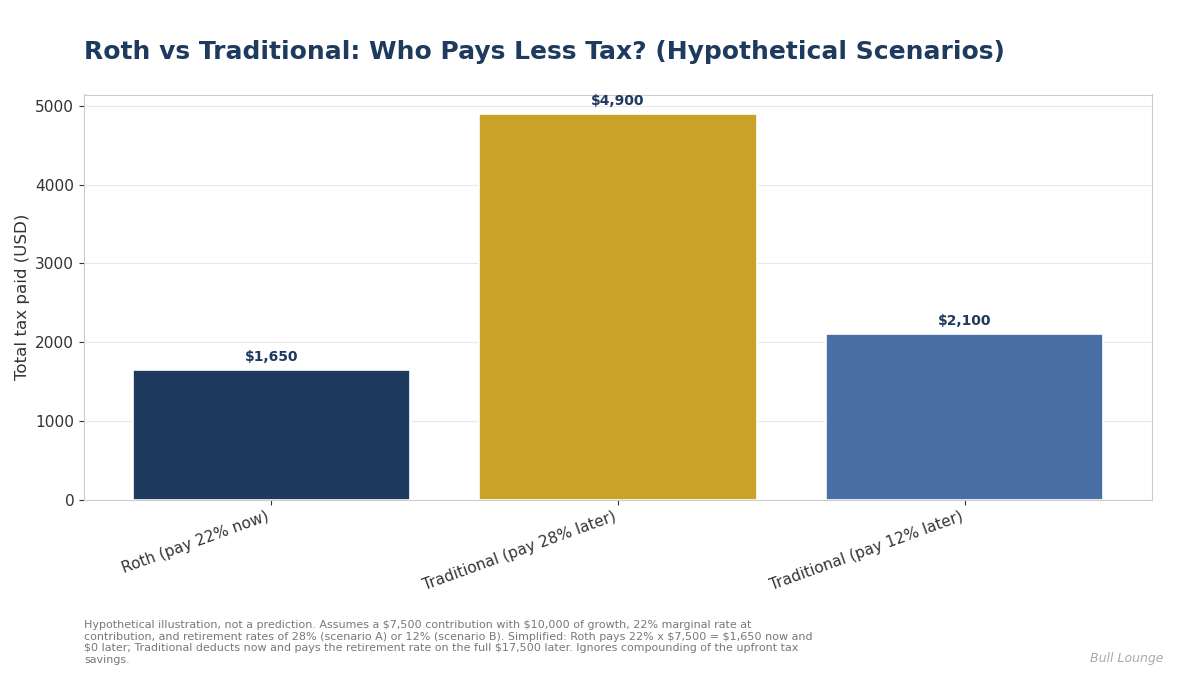
If the lists above leave you torn, use this one-question test: will my marginal tax rate be higher now or in retirement? If the answer is “higher later,” lean Roth. If it is “higher now,” lean Traditional. And remember you do not have to pick just one: holding both pre-tax and Roth assets gives you control over your taxable income in retirement, letting you pull from each bucket strategically year by year.
The Backdoor Roth IRA for High Earners
Earn too much to contribute directly to a Roth IRA? The tax code still leaves a door open. There is no income limit on converting Traditional IRA money to Roth — only on direct contributions. So high earners commonly make a non-deductible contribution to a Traditional IRA and then convert it to a Roth shortly after. This two-step maneuver is known as the backdoor Roth IRA.
The critical trap is the pro-rata rule. If you already hold pre-tax money in any Traditional, SEP, or SIMPLE IRA, the IRS treats a conversion as coming proportionally from all your IRA balances — you cannot cherry-pick just the after-tax dollars to convert tax-free. Track non-deductible contributions on IRS Form 8606 so you do not pay tax twice on the same dollars.
Common Mistakes to Avoid
- Exceeding the combined limit. The $7,500 / $8,600 cap applies across all your IRAs put together, not per account.
- Assuming the Traditional deduction is automatic. If you are covered by a workplace plan and earn above the phase-out range, your contribution may be non-deductible — confirm before counting on the tax break.
- Forgetting the Roth 5-year rule. Tax-free treatment of earnings requires the account to be open at least five years (plus age 59½). Each conversion has its own five-year clock for the converted amount’s penalty-free access.
- Ignoring the pro-rata rule. A backdoor Roth with existing pre-tax IRA balances usually creates a bigger tax bill than expected. Rolling pre-tax balances into a 401(k) first is a common workaround.
- Raiding Roth earnings early. Contributions are always accessible, but early earnings withdrawals generally mean income tax plus a 10% penalty.
Frequently Asked Questions
Can I contribute to both a Roth and a Traditional IRA in the same year?
Yes. The annual limit is combined — for 2026, your total contributions across both accounts cannot exceed $7,500 (or $8,600 if 50+).
What if my income is too high for a direct Roth contribution?
You can still use the backdoor Roth strategy: make a non-deductible Traditional IRA contribution and convert it to Roth. Just watch the pro-rata rule if you hold other pre-tax IRA balances.
When do required minimum distributions start?
For Traditional IRAs, RMDs currently begin at age 73 and rise to 75 under SECURE 2.0. Roth IRAs have no RMDs for the original owner during their lifetime.
Can I withdraw Roth IRA contributions before retirement?
Yes — your contributions can be withdrawn at any time without taxes or penalties. Only the earnings are subject to the 5-year rule and the 59½ age requirement for tax-free treatment.
The Bottom Line
Whichever you choose, the most expensive mistake is contributing to neither. Pick the account that fits, automate the contribution, and let compounding do the heavy lifting.
Not financial advice. Do your own research.
Sources
- Kiplinger — Roth IRA Limits
- National Tax Tools — Roth IRA Contribution Limits Guide
- Retired in USA — 2026 Roth IRA Limits: What Savers Need to Know
