 BTC
BTC  ETH
ETH  XRP
XRP SOL
SOL  DOGE
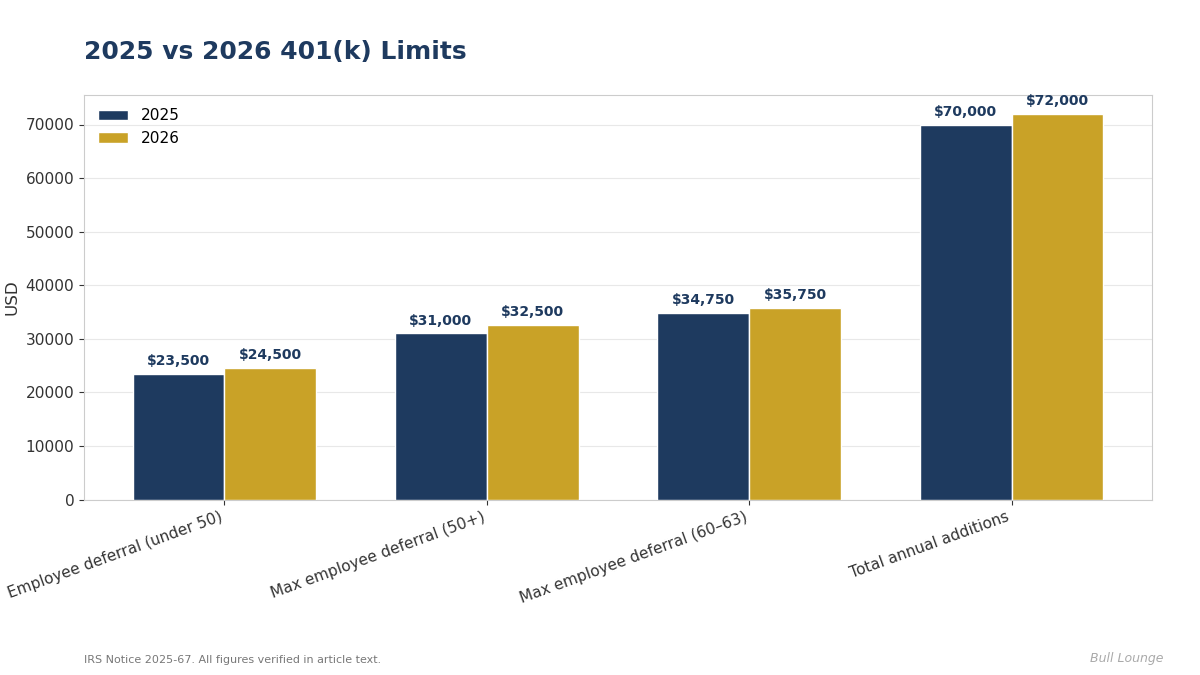
DOGE The IRS has released the 2026 retirement plan limits, and the headline for workers is straightforward: you can shelter more of your paycheck. For 2026, the employee elective deferral limit rises to $24,500, up $1,000 from $23,500 in 2025.
That single cap covers 401(k), 403(b), most governmental 457(b) plans, and the federal Thrift Savings Plan. It also comes with higher catch-up limits for workers 50 and older — plus a new SECURE 2.0 rule that changes how high earners make those catch-up contributions.
Here is every 2026 number that matters, in plain English.
2026 401(k) Contribution Limits at a Glance
All figures below come from IRS Notice 2025-67. The $24,500 employee deferral limit is the number most workers should focus on.
| Limit | 2025 | 2026 |
|---|---|---|
| Employee elective deferral (under age 50) | $23,500 | $24,500 |
| Catch-up contribution (age 50+) | $7,500 | $8,000 |
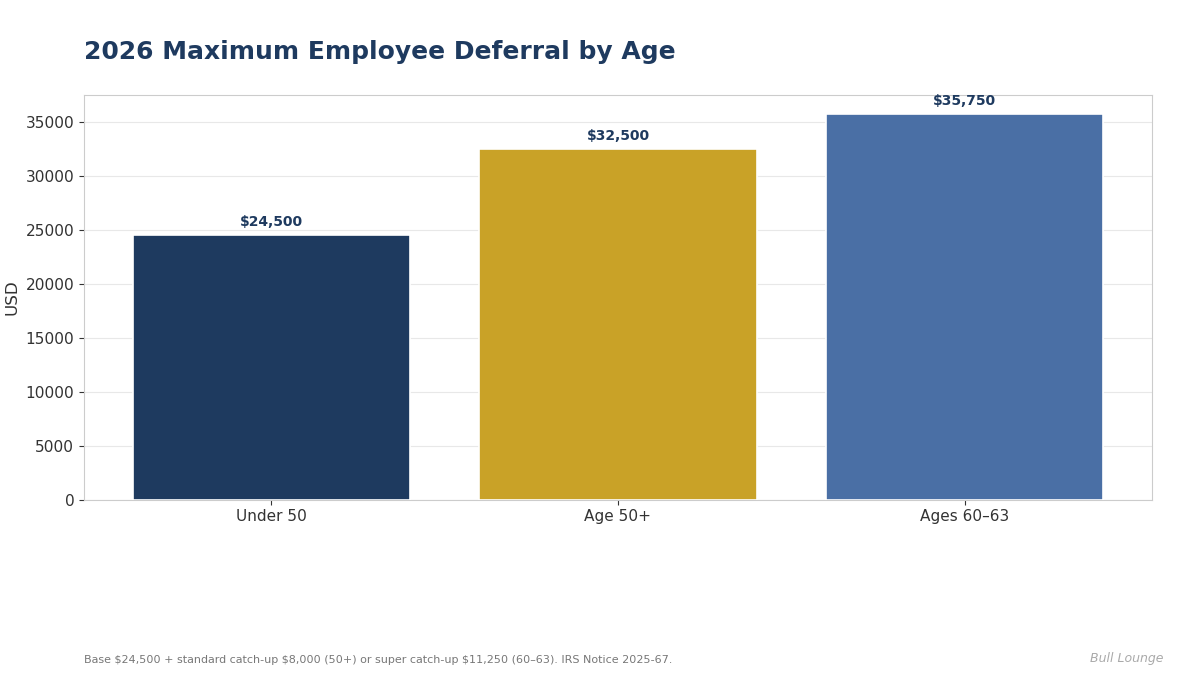
| Maximum employee deferral (age 50+) | $31,000 | $32,500 |
| Super catch-up (ages 60–63) | $11,250 | $11,250 |
| Maximum employee deferral (ages 60–63) | $34,750 | $35,750 |
| Total annual additions (employee + employer) | $70,000 | $72,000 |
| Compensation counted for plan formulas | $350,000 | $360,000 |
Note that the super catch-up for ages 60–63 did not change — $11,250 was introduced in 2025 and holds steady for 2026. The higher employee maximums this year come from the base limit increase.
What Counts Toward the $24,500 Limit
Your elective deferrals are the contributions you choose to pull from your paycheck. Both pre-tax (traditional) and Roth 401(k) contributions count toward the same $24,500 cap — you cannot contribute $24,500 of each.
Counts toward the cap:
- Pre-tax 401(k) contributions
- Roth 401(k) contributions
- Elective deferrals to a 403(b), most governmental 457(b) plans, or the federal TSP
Does not count toward the cap:
- Employer matching contributions
- Employer profit-sharing or nonelective contributions
- Catch-up contributions, if you are eligible
- After-tax (non-Roth) contributions, which fall under the separate $72,000 total limit
One detail many workers miss: the $24,500 cap follows you, not your plan. If you change jobs mid-year and contribute to two different 401(k)s, the limit applies to the combined total — not $24,500 per plan.
Catch-Up Contributions: Two Tiers
Workers who turn 50 or older during the calendar year can contribute beyond the standard limit. For 2026, the standard catch-up rises to $8,000, lifting the maximum employee deferral to $32,500.
The standard catch-up (age 50 and older)
At $8,000 for 2026 (up from $7,500), this is the tier most older workers use. It applies automatically once you are eligible — you do not need to enroll separately, though you do need to elect the higher deferral amount with your plan.
The “super” catch-up (ages 60–63)
SECURE 2.0 created a larger catch-up window for workers ages 60 through 63: $11,250 for 2026, unchanged from 2025. Combined with the higher base limit, that allows up to $35,750 in employee deferrals this year.
Once you turn 64, you fall back to the standard $8,000 catch-up. The super catch-up is strictly an ages-60-to-63 benefit.
New for 2026: The Roth Catch-Up Rule for High Earners
A SECURE 2.0 provision that was delayed twice finally takes effect in 2026. If you are 50 or older and your wages in 2025 exceeded $150,000, your catch-up contributions must be made as Roth (after-tax) contributions.
In practice, that means you pay income tax on the catch-up dollars now, and qualified withdrawals later are tax-free. Your regular $24,500 of deferrals can still be pre-tax — only the catch-up portion is affected.
If your 2025 wages were $150,000 or less, nothing changes. You can keep making catch-up contributions pre-tax if you prefer.
One wrinkle worth checking early: if your employer’s plan does not offer a Roth contribution option, affected high earners may be unable to make catch-up contributions at all. Ask your plan administrator before the year gets away from you.
Employer Match vs. Your Personal Limit
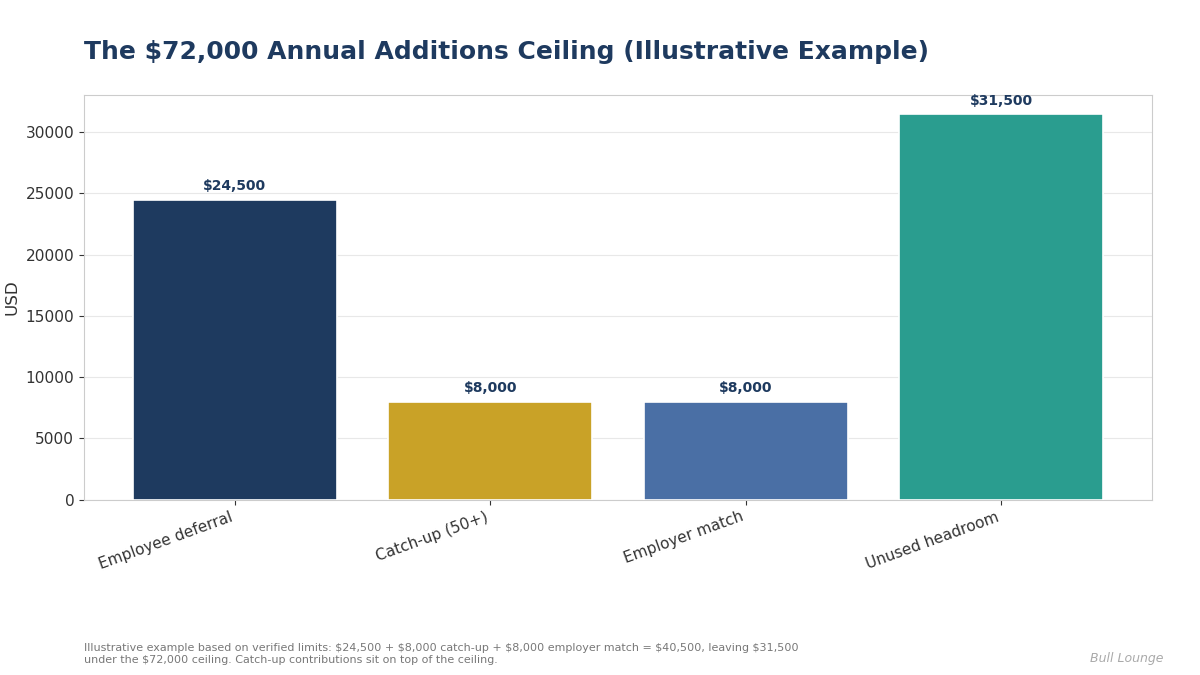
Your employer’s matching dollars never eat into your $24,500. They count only toward the overall $72,000 annual additions limit, which covers everything flowing into your account: your deferrals, the match, profit-sharing, and forfeitures.
A quick example: you defer the full $24,500 and your employer matches $8,000. Total additions come to $32,500 — comfortably below the $72,000 ceiling. Most workers never approach the ceiling, but highly compensated employees maxing out every available bucket should keep it on their radar.
Catch-up contributions sit on top of the $72,000 ceiling rather than inside it, so a worker 50 or older could see up to $80,000 in total annual additions for 2026.
How Much to Contribute Per Paycheck
To hit the full $24,500 across the year, here is what each paycheck needs to carry:
| Pay schedule | Per paycheck |
|---|---|
| Weekly (52 paychecks) | $471.15 |
| Biweekly (26 paychecks) | $942.31 |
| Semimonthly (24 paychecks) | $1,020.83 |
| Monthly (12 paychecks) | $2,041.67 |
For most workers, the biweekly figure is the one that matters: about $942 per paycheck maxes out the 2026 limit. Payroll systems round these amounts, and most plans automatically stop your contributions once you reach the IRS cap.
If maxing out is not realistic this year, anchor on the match instead. On a $100,000 salary, contributing 10% means $10,000 a year — roughly $385 per biweekly paycheck — and capturing the full employer match is the first milestone most planners recommend.
Watch your pace if you get a mid-year raise or bonus. Hitting the cap too early can cost you later matching contributions, since many plans only match each pay period. Some plans “true up” the match at year-end — many do not. Check your plan documents.
What Happens If You Over-Contribute
Exceeding your elective deferral limit — $24,500, or $32,500/$35,750 with catch-ups — creates an “excess deferral.” The fix is to withdraw the excess, generally by April 15 of the following year.
Miss that deadline and the tax treatment gets painful: the excess is taxed in the year you contributed it, and taxed again when you eventually withdraw it. Double taxation on the same dollars is the outcome everyone wants to avoid.
Most single-employer plans cut off your contributions automatically at the cap. The real danger zone is working for two employers in one year — neither plan sees the other’s totals. Track your year-to-date deferrals on your pay stubs, and if you spot an excess, contact your plan administrator right away to request a corrective distribution.
Frequently Asked Questions
Is the $24,500 limit per plan or per person?
Per person. It covers the combined total of your elective deferrals across every 401(k), 403(b), governmental 457(b), and TSP account you contribute to in the calendar year.
Do employer matching contributions count toward my $24,500?
No. The match counts only toward the $72,000 total annual additions limit.
Can I max out a 401(k) and an IRA in the same year?
Yes — the limits are separate. For 2026, you can contribute up to $7,500 to a traditional or Roth IRA on top of your 401(k), plus a $1,100 catch-up if you are 50 or older, for a total of $8,600. Income limits apply to Roth IRA eligibility and traditional IRA deductibility.
I turn 60 this year. Which catch-up do I get?
The $11,250 super catch-up, since you fall in the 60–63 window. Your maximum employee deferral for 2026 is $35,750. One caveat: if your 2025 wages exceeded $150,000, that $11,250 must go in as Roth under the new rule.
What if my plan has no Roth option and I am subject to the new Roth catch-up rule?
You may not be able to make catch-up contributions at all until your employer adds a Roth feature. Raise it with your plan administrator or HR early in the year.
The Bottom Line
The 2026 limits give savers a little more room: $24,500 for most workers, up to $32,500 at age 50+, and up to $35,750 in the 60–63 window. High earners should confirm their plan supports Roth catch-ups before January, and anyone with two jobs in one year should track the combined total themselves.
If the full limit is out of reach, automate what you can and raise your rate by a percentage point each year. Consistency beats intensity in retirement saving.
Not financial advice. Do your own research.
Sources
- Bear Savings — 401(k) Contribution Limits 2026
- InvestorMint — 2026 SECURE 2.0 401(k) Catch-Up Contributions
- Inova Payroll — IRS 2026 Retirement Plan Contribution Limits
