 BTC
BTC  ETH
ETH  XRP
XRP SOL
SOL  DOGE
DOGE Parents saving for a child’s future just got a second option. For decades, the 529 plan was the default tax-advantaged account for kids. Then on July 4, 2026, Trump Accounts went live — federal savings accounts that hand eligible newborns a $1,000 head start from the U.S. Treasury.
So which one deserves your money? The honest answer: they do different jobs. The 529 is an education account with unmatched tax treatment for college costs. The Trump Account is a long-term wealth starter with free seed money and no education requirement. This guide compares them side by side so you can decide — or use both.
The 529 Plan, in 60 Seconds
A 529 is a state-run, tax-advantaged account built for education savings. You contribute after-tax dollars, the money grows tax-deferred, and withdrawals are completely tax-free when used for qualified education expenses: college tuition, room and board, books, K-12 tuition (up to $10,000 per year), apprenticeship programs, and up to $10,000 lifetime for student loan repayment.
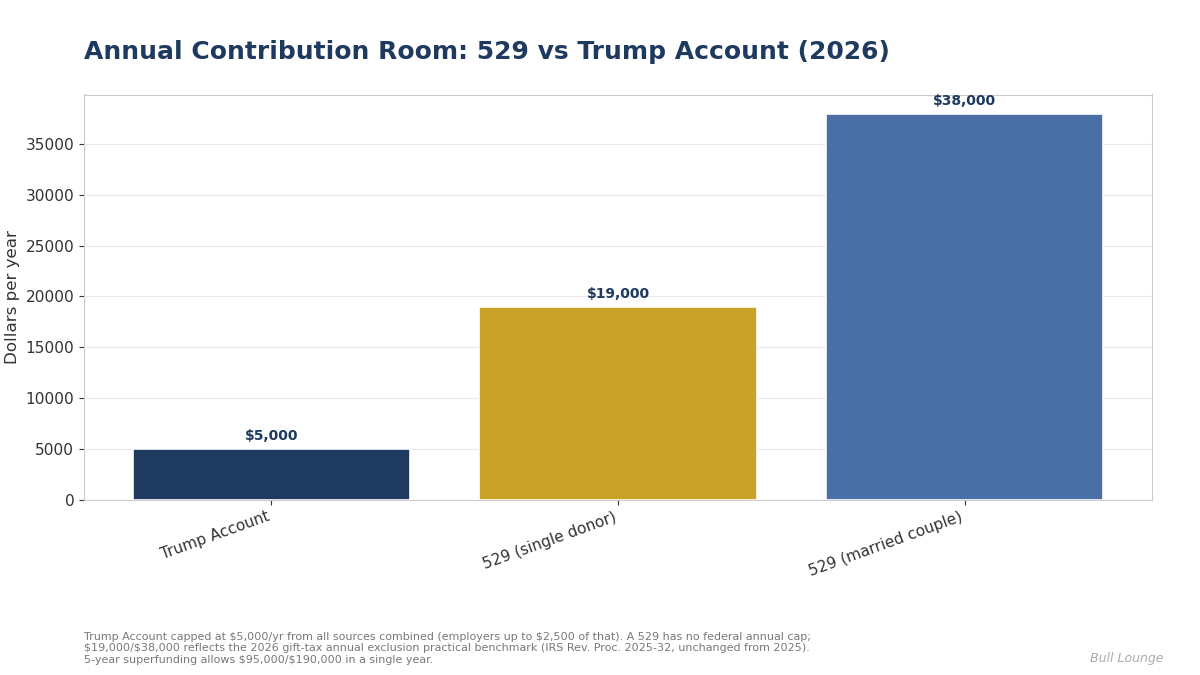
There is no federal annual contribution limit. In practice, families use the gift-tax annual exclusion as their benchmark: $19,000 per donor per child in 2026 ($38,000 for a married couple). A special “superfunding” election lets you front-load five years at once — $95,000 from one donor or $190,000 from a couple — without touching your lifetime exemption.
The parent owns the account and stays in control, including the right to change the beneficiary to another family member. Many states also offer a state income-tax deduction for contributions. If money comes out for non-education spending, the earnings portion is taxed as income plus a 10% federal penalty.
One more escape hatch: under SECURE 2.0, up to $35,000 of unused 529 funds can be rolled into the beneficiary’s Roth IRA over their lifetime — provided the 529 has been open at least 15 years, the money being moved is at least five years old, and annual Roth contribution limits are respected.
The Trump Account, in 60 Seconds
A Trump Account is a new federal savings account for children, created under the One Big Beautiful Bill Act. Any child under 18 with a Social Security number can have one. Children born between January 1, 2025 and December 31, 2028 who are U.S. citizens get a one-time $1,000 deposit from the Treasury once the account is activated.
Families, grandparents, friends, and employers can add up to $5,000 per child per year combined (employers up to $2,500 of that). The money is invested in low-cost U.S. stock index funds, and withdrawals are generally not allowed until the child turns 18. At 18, the account converts to a traditional IRA owned by the (now adult) child, and withdrawals are taxed as ordinary income.
Parents open the account by filing IRS Form 4547 at trumpaccounts.gov. More than 7 million children had been signed up as of fall 2026. A separate private pledge from Michael and Susan Dell ($6.25 billion) may add $250 for some younger children in lower-income ZIP codes — but that is charity, not a federal benefit.

529 vs Trump Account: Side by Side
| Feature | 529 Plan | Trump Account |
|---|---|---|
| Primary purpose | Education savings | Long-term savings / retirement head start |
| Tax on contributions | After-tax (many states offer a deduction) | After-tax (no deduction) |
| Tax on growth | Tax-deferred | Tax-deferred |
| Tax on withdrawals | Tax-free for qualified education expenses | Taxed as ordinary income after 18 (traditional IRA rules) |
| Annual contribution room | No federal cap; $19,000 gift-tax exclusion is the practical benchmark ($95,000 superfund) | $5,000 per year from all sources combined |
| Federal seed money | None | $1,000 one-time (births 2025–2028) |
| Who controls it | Account owner (usually the parent); can change beneficiary | Parent as custodian until 18; the child owns it at 18 |
| What it can be used for | Education: college, K-12, apprenticeship, student loans | Anything after 18 (designed for retirement) |
| If plans change | Change beneficiary, or roll up to $35,000 into a Roth IRA | Becomes the child’s traditional IRA — no penalty for non-education use |
When the 529 Wins
If college or trade school is the goal, the 529’s tax treatment is unbeatable: tax-free in, tax-free growth, tax-free out for education. No other account lets money escape taxation on both ends. For a family that can save aggressively, the contribution room is far larger — a married couple can move $38,000 per child per year under the gift-tax exclusion, or superfund $190,000 at once.
The 529 also wins on control and flexibility. The parent owns the account, can redirect it to a sibling if one child skips college, and — thanks to SECURE 2.0 — can rescue up to $35,000 of leftovers into the child’s Roth IRA. Add a state tax deduction in many states, and the 529 remains the heavyweight for education funding.
When the Trump Account Wins
The Trump Account’s killer feature is free money: a $1,000 Treasury deposit that no 529 can match. For a newborn, that seed gets up to 18 years of compounding before it converts to an IRA — a head start that costs the family nothing to claim.
It also wins when college is uncertain. A 529 penalizes non-education withdrawals; a Trump Account has no education requirement at all. If your child becomes an entrepreneur, goes straight to work, or you simply want a dedicated retirement starter for them, the Trump Account is the simpler, more flexible vehicle. Setup is one federal form instead of shopping among 50 state plans.
Can You Use Both? Yes — Here’s How They Complement Each Other
For most families this isn’t either/or. Think of the 529 as the education fund and the Trump Account as the everything-else fund. A sensible split: fund the 529 first if college is likely, since education dollars get the best tax treatment there, then claim the Trump Account seed and add up to $5,000 a year as a bonus retirement starter for your child.
The math supports the pairing. The Trump Account’s $5,000 annual cap is modest next to real college costs — it can’t carry tuition on its own. But as a supplement, 18 years of contributions compounding in index funds can become a meaningful young-adult nest egg. Meanwhile the 529 handles the big, earmarked education bill with tax-free withdrawals.
One practical note: anyone can contribute to a Trump Account — grandparents included — but every dollar counts toward the same $5,000 yearly cap. Coordinate with relatives so surprise birthday checks don’t accidentally push you over.
FAQs
Is the $1,000 Trump Account deposit real?
Yes. Children born January 1, 2025 through December 31, 2028 who are U.S. citizens with Social Security numbers receive a one-time $1,000 Treasury deposit once the account is opened and activated. Children outside that window can still have an account, just without the seed money.
Can grandparents contribute to either account?
Yes to both. Grandparents can contribute to a 529 (superfunding is popular for estate planning) and to a Trump Account. Trump Account contributions from all sources share the $5,000 annual cap.
What if my child doesn’t go to college?
With a 529, you can change the beneficiary to another family member or roll up to $35,000 into the child’s Roth IRA (15-year account age and other rules apply). With a Trump Account, nothing is wasted — it simply becomes the child’s traditional IRA at 18.
Do Trump Account contributions get a state tax deduction like 529s?
No. Trump Accounts are a federal program with no state tax deduction. Many states offer deductions for 529 contributions — check your state’s plan.
Which should I open first?
If college is likely, open the 529 first — its education tax treatment is the most valuable benefit on this page. Then open the Trump Account to claim the $1,000 seed (if eligible) and add whatever fits your budget. The seed money is free; leaving it unclaimed is the only real mistake.
The Bottom Line
The 529 remains the best tool for education savings: bigger contribution room, tax-free withdrawals for school, and parental control. The Trump Account is the best freebie in personal finance right now — $1,000 of seed money, no education strings attached, and a built-in conversion to a retirement account at 18. Most families with young children should have both: the 529 for the diploma, the Trump Account for the head start.
Not financial advice. Do your own research.
Sources: Saving to Invest — Trump Accounts 2026, USA Today — How Trump Accounts work, Abacus Wealth — 529, 530A (Trump Account), or UTMA, IRS — Gift tax FAQs (2026 annual exclusion $19,000), Saving for College — 529 to Roth IRA rollover rules, Empower — 529 to Roth IRA rollover guide
