 BTC
BTC  ETH
ETH  XRP
XRP SOL
SOL  DOGE
DOGE As of early September 2026, U.S. spot bitcoin ETFs alone hold more than 1.24 million BTC — roughly 6% of bitcoin’s circulating supply — and a growing share sits inside retirement accounts. If you want crypto working for your retirement instead of a taxable exchange account, you have options. This guide covers what a Bitcoin IRA is, the three ways to get crypto into a retirement account, what it costs, how it’s taxed, and the risks nobody should skip.
What a Bitcoin IRA Actually Is
A Bitcoin IRA is a self-directed individual retirement account (IRA) that holds bitcoin — or other cryptocurrencies — through a specialized custodian. The IRS treats cryptocurrency as property, and the self-directed IRA structure allows an IRA to hold property beyond the stocks and bonds a standard brokerage offers, as long as an IRS-approved custodian holds it.
It works like any other IRA — tax-advantaged growth, penalties for early withdrawals — except for what’s inside. Trades executed inside the IRA don’t trigger capital gains taxes the way selling crypto in a taxable account would.
There are three main routes to crypto exposure in a retirement account:
- Spot bitcoin ETF in a standard IRA. Buy shares of a spot bitcoin ETF inside your existing Fidelity, Schwab, or Vanguard IRA. Simplest and cheapest — but you own ETF shares, not actual coins, and you can’t move coins in or out.
- Specialist crypto IRA. Providers built for this (examples include iTrustCapital, Alto, and BitcoinIRA.com) let you hold actual coins inside a Traditional, Roth, or rollover IRA, usually with a wider coin menu and 24/7 trading.
- Fidelity Crypto IRA. Launched in 2025: bitcoin, ethereum, litecoin, and solana inside a Fidelity IRA, custodied by Fidelity Digital Assets. Not available in every state — California and Oregon are excluded.
A standard brokerage IRA won’t let you buy spot bitcoin directly — a provider limitation, not an IRS rule, which is why specialist custodians exist.
How It Works: The Self-Directed Mechanics
Opening a crypto IRA follows the same skeleton as any IRA, with a few crypto-specific twists:
- Choose a custodian or provider. For actual coins, you need a self-directed IRA custodian set up for digital assets. For the ETF route, your current brokerage works.
- Fund it with U.S. dollars. This is an IRS hard rule: you cannot transfer crypto you already own into an IRA. All contributions and rollovers must arrive as cash, and the custodian executes the coin purchases inside the account.
- Buy inside the account. You direct purchases through the provider’s platform; the custodian handles IRS reporting (Forms 5498 and 1099-R), enforces contribution limits, and holds the assets.
- You never hold the keys. IRS regulations prohibit personal possession of IRA assets. The coins must sit with a qualified custodian or approved custody solution — typically cold storage — or the account’s tax-advantaged status is at risk.
Contribution limits are identical to any IRA: $7,500 for 2026 if you’re under 50, or $8,600 if you’re 50 or older. Rollovers from a 401(k) or another IRA aren’t capped by that limit. Withdrawal rules match too: 10% early-withdrawal penalty before age 59½, and required minimum distributions starting at 73 for Traditional accounts.
Roth vs. Traditional: The Tax Treatment
The wrapper matters more than usual with crypto, because the whole point is shielding outsized gains from tax. Here’s how the two main wrappers compare:
| Traditional Crypto IRA | Roth Crypto IRA | |
|---|---|---|
| Contributions | Possibly tax-deductible, depending on income and workplace-plan coverage | After-tax; no deduction |
| Growth | Tax-deferred | Tax-free |
| Withdrawals | Taxed as ordinary income | Tax-free if qualified (59½ and 5-year rule met) |
| Required minimum distributions | Start at age 73 | None for the owner |
| 2026 contribution limit | $7,500 (under 50) / $8,600 (50+) | |
| Best fit | You expect a lower tax rate in retirement | You expect big growth or higher future taxes |
The Roth version has particular logic for crypto: if your bitcoin allocation compounds dramatically over decades, none of that gain is taxed on the way out — at the cost of paying tax on contributions now, with no deduction.
Fees to Watch
This is where crypto IRAs diverge most from a plain index-fund IRA. Fee schedules vary enormously and can quietly consume tens of thousands of dollars over decades. Watch three layers:
- Setup fees. Often range from zero up to a few percent of your initial funding amount. Some providers charge a flat setup fee instead.
- Trading costs. Providers often charge around a 1–2% spread or transaction fee per trade — every buy and every sell. Fidelity’s Crypto IRA charges a 1% spread with no separate account or custody fees. The Motley Fool reported one major provider’s published schedule as a 2% transaction fee plus monthly maintenance — always confirm the current schedule before opening.
- Custody and maintenance. Often a flat monthly fee (commonly in the $20–30 range) or a small percentage of assets per month, on top of trading costs.
To see why this matters, consider the illustrative compounding math below:
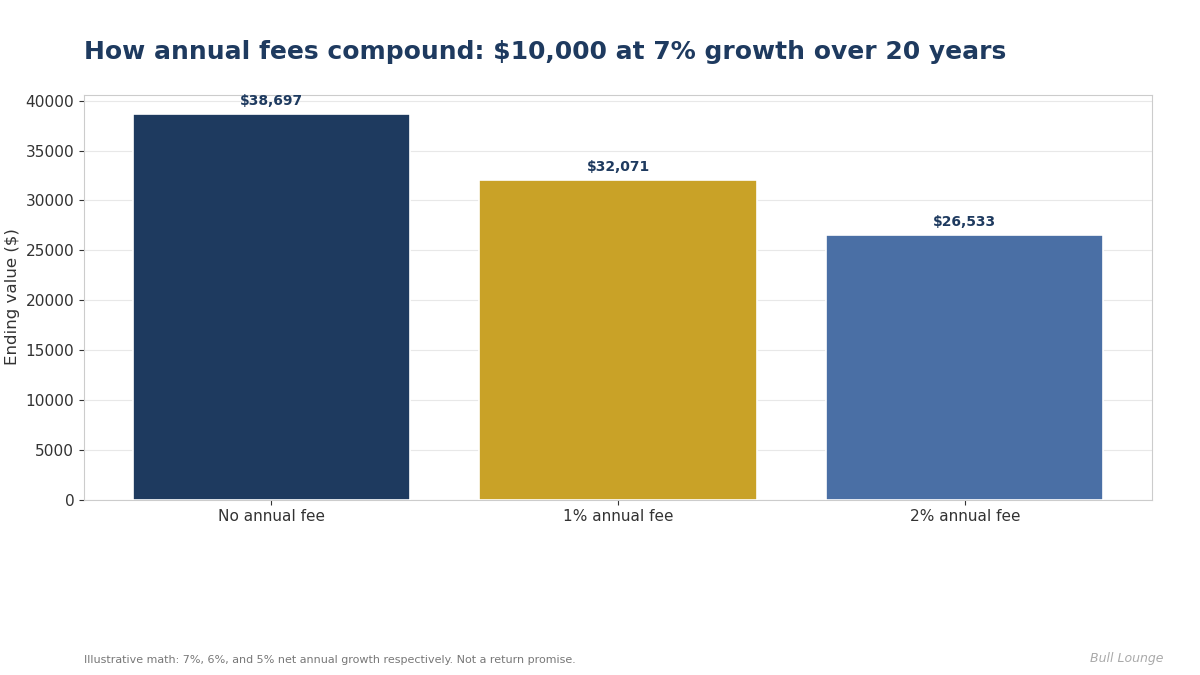
A 1% annual drag doesn’t sound like much until you compound it across twenty years. Compare any provider’s all-in cost against simply holding a spot bitcoin ETF in your existing IRA, where you’d pay only the ETF’s expense ratio.
Risks Unique to Crypto IRAs
Beyond normal market risk, crypto IRAs carry risks that barely exist in a stock-and-bond IRA:
- Volatility on retirement money. Bitcoin hit an all-time high just above $126,000 in October 2025, then traded around $76,000–$78,000 in mid-September 2026 — a drawdown of roughly 39%. That’s the asset doing what it does. Inside a retirement account you can’t easily rebalance away from it without selling.
- Custody and hacking risk. Your coins sit with a third party. Ask how assets are segregated, whether the provider can lend them out, and what happens to your coins if the company fails.
- No SIPC safety net for crypto. SIPC protection covers securities at brokerages — it generally does not extend to crypto assets. If your provider has private insurance, read what it actually covers.
- Prohibited transactions can nuke the account. Under IRC Section 4975, self-dealing — like routing staking or DeFi activity to benefit yourself rather than the IRA — can disqualify the entire IRA. Mining inside an IRA is typically treated as unrelated business taxable income.
- Provider and lock-up risk. Some platforms restrict transfers — with Fidelity’s Crypto IRA, for example, only dollars move in or out, never coins. If a platform freezes withdrawals, your exit may be limited to selling to cash.
Who It’s For — and Who Should Skip It
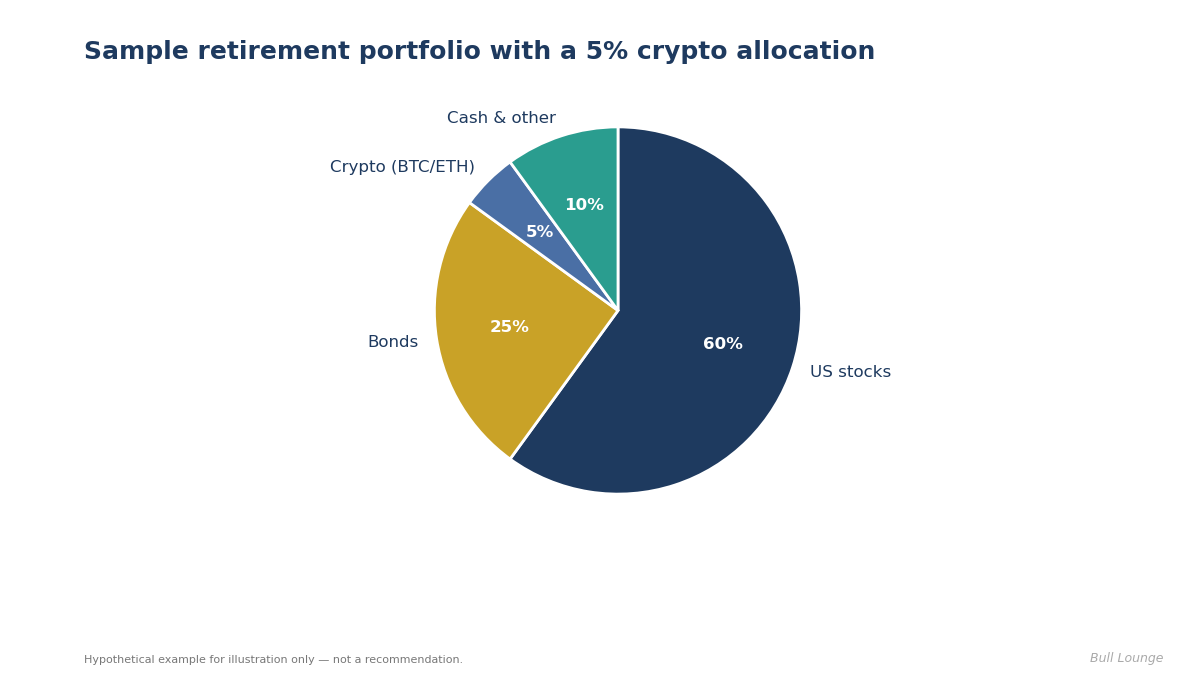
A crypto IRA tends to make sense if you already fund your core retirement accounts, have a long time horizon, understand bitcoin’s drawdowns, and want the tax wrapper around a satellite allocation — not a core holding. A 5% crypto slice is a common illustrative starting point:
Skip it — or use the ETF route only — if you’re near retirement, haven’t captured your full 401(k) employer match, or if the fee schedule isn’t clearly cheaper than a spot bitcoin ETF in your existing IRA. And if anyone pitches you a crypto IRA with promises about returns, walk away.
FAQs
Can I transfer bitcoin I already own into an IRA?
No. IRS rules require all IRA funding in U.S. dollars. The custodian buys the coins inside the account after your cash arrives.
Can I buy actual bitcoin in my existing Schwab or Vanguard IRA?
No — those brokerages offer crypto only through ETFs or futures, not spot coins. For actual coins you need a specialist self-directed custodian.
Is crypto in an IRA insured?
Not by SIPC. SIPC covers securities, not crypto assets. Some providers carry private insurance — read the policy, not the marketing.
Can I stake Ethereum or Solana inside a crypto IRA?
It depends on the provider — some specialist platforms support staking, Fidelity’s Crypto IRA currently doesn’t. Staking inside a retirement wrapper raises its own tax questions, so check with a tax professional first.
What happens to my crypto IRA if the provider goes bankrupt?
It depends on the custody agreement: how assets are titled, whether they’re segregated from company assets, and what the contract says about liens and setoff. Ask for this in writing before you fund.
The Bottom Line
A Bitcoin IRA is a legitimate way to put crypto in a tax-advantaged wrapper — the IRS allows it, limits match regular IRAs, and the Roth version can make long-term gains tax-free. But the wrapper doesn’t tame the asset: fees are higher, custody is third-party, and the volatility is unchanged. For most people, the cleanest entry is a small allocation via a spot bitcoin ETF in the IRA they already have.
Not financial advice. Do your own research.
Sources:
Bitcoin.com — What Is a Bitcoin IRA? (2026)
Fidelity — Fidelity Crypto IRA
Crypto.com — What Is a Crypto IRA & How Does It Work?
TechFinancials — Best Crypto IRA 2026: Fees, Security and Investment Options
IRA Financial — How to Add Crypto to Your Retirement Account (2026)