 BTC
BTC  ETH
ETH  XRP
XRP SOL
SOL  DOGE
DOGE - This topic is empty.
-
AuthorPosts
-
October 15, 2026 at 11:15 am #2412
The worst wholesale inflation print in four years just landed — and the market barely blinked. A market commentator’s viral take argues that’s exactly the right reaction: the Fed doesn’t hike rates just because an inflation number printed hot. The data backs him up. But there’s a catch he’s missing. Here’s the full breakdown.
The September Producer Price Index, released Thursday morning, was a genuine shock. Yet bonds rallied, October rate-hike odds didn’t move at all, and Bitcoin dipped then held. Let’s walk through what happened, why the shrug makes sense — and where the “it doesn’t matter” argument goes too far.
The Shock: PPI’s Worst Print Since 2022
The numbers were objectively ugly. The PPI for final demand jumped 1.3% in September — the largest monthly gain since March 2022 — and more than double the 0.5% economists expected. On an annual basis, wholesale inflation hit 6.3%, the highest since December 2022.
Measure September Forecast August Headline PPI (m/m) +1.3% +0.5% +0.5% (revised) Headline PPI (y/y) +6.3% +5.3–5.5% +5.6% Core PPI ex-food/energy (m/m) +0.7% +0.3% +0.2% Core PPI ex-food/energy (y/y) +5.0% +4.4–4.5% +4.6% Energy (m/m) +10.8% — — Gasoline (m/m) +20.3% — — It was the third straight monthly acceleration in the year-over-year rate. Coming a day after a hot CPI (3.7% y/y), this looked like the one-two punch that forces the Fed’s hand. It wasn’t.
The Shrug: Markets Said “So What?”
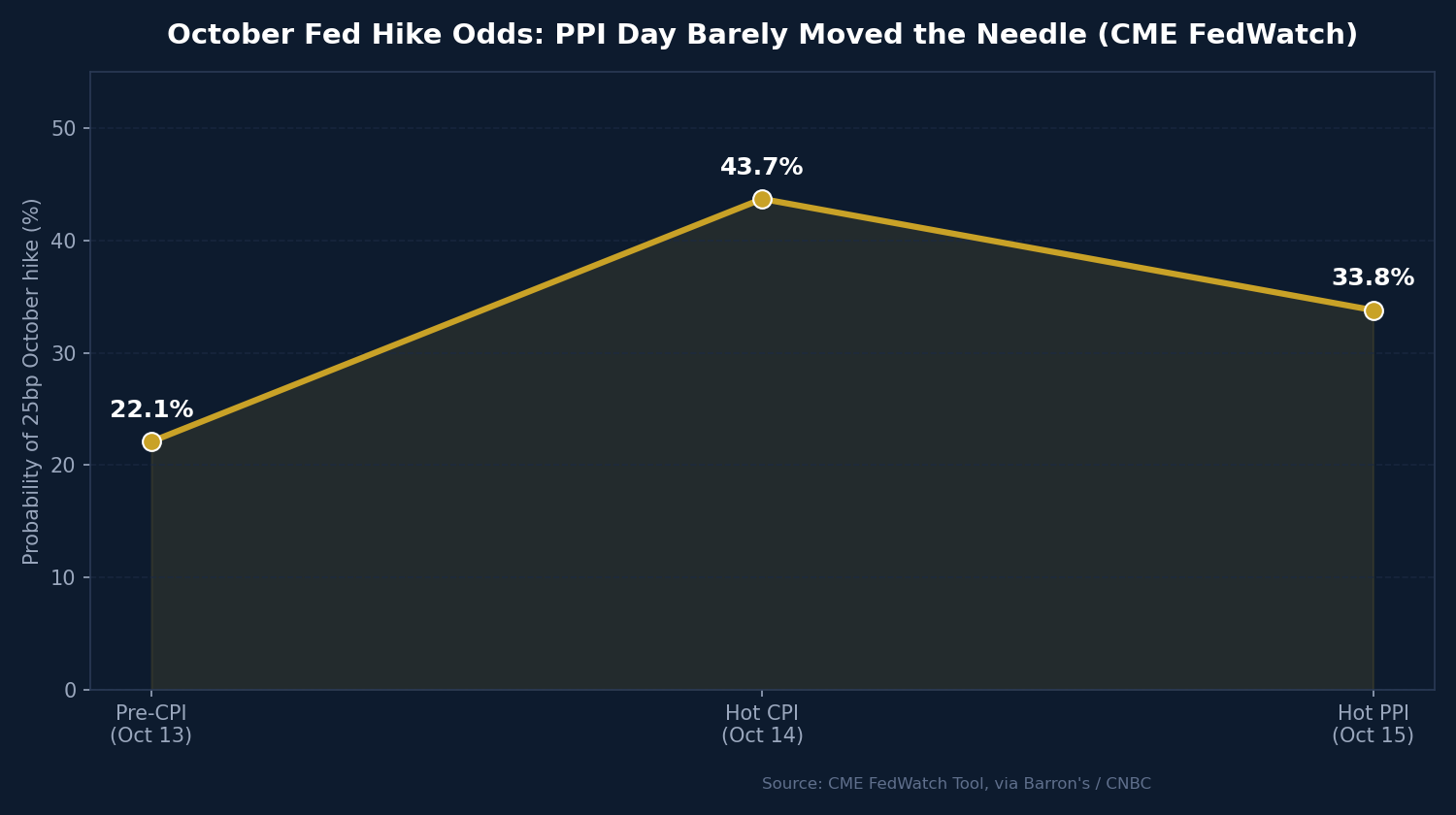
October Fed hike odds (CME FedWatch): the hot PPI print didn’t move the needle. Source: Barron’s/CNBC.
Here is the single most important chart of the day. Before CPI, October hike odds sat at 22%. The hot CPI print nearly doubled them to 44%. Then the “worst in four years” PPI arrived — and odds sat at 33.8%, essentially unchanged from the day before.
Bond traders agreed. The 10-year Treasury yield fell 13–14 basis points to 5.05% on PPI day — the opposite of what a genuine inflation scare produces. When bonds rally into hot inflation data, the market is telling you the print doesn’t change the policy path.
Bitcoin told the same story: it slipped about $500 to $80,443 on the release, then stabilized near $81,500. A dip, not a breakdown.
Why the Shrug Is Right: Three Reasons PPI Doesn’t Matter (Much)
The viral argument gets the mechanics right. Here’s the professional version of the same logic:
1. The Fed doesn’t target PPI — it targets PCE. The Federal Reserve’s 2% goal is defined in terms of the Personal Consumption Expenditures index, not producer prices. PPI is a “supporting character”: useful as an early read on pipeline pressures, but it never appears in the Fed’s reaction function. As one markets explainer puts it, CPI moves markets today, but PCE is what sits closest to the Fed’s policy framework.
2. The surge was an energy story, not a demand story. Energy prices jumped 10.8% in a single month and accounted for more than 80% of the increase in goods prices, per the BLS. Gasoline alone (+20.3%) drove roughly half the monthly gain. This is a supply shock from the US-Israeli war with Iran squeezing oil — painful, but the kind of one-time price-level shift that central banks historically look through, because hiking rates doesn’t produce more gasoline.
3. Hot inflation only hurts risk assets through the rate-hike channel. This is the video’s core insight, and it’s correct. The causal chain isn’t “hot print → stocks bad.” It’s “hot print → Fed hikes → higher discount rates → stocks bad.” If the Fed was never going to hike on this data, the data can’t hurt. And the FedWatch odds show the market concluded exactly that.
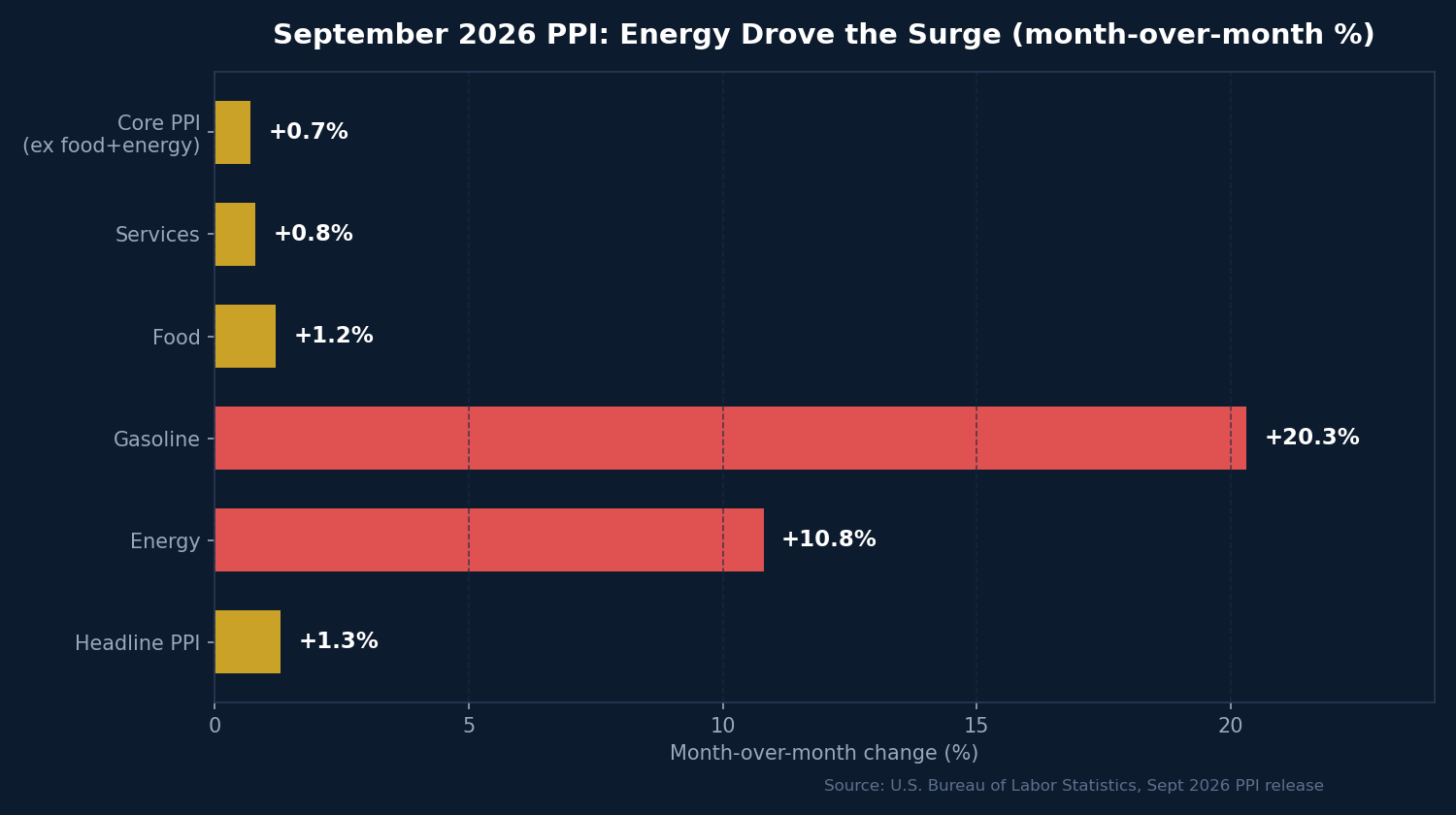
September PPI by component: the headline was an energy shock. Source: U.S. Bureau of Labor Statistics.
What the Experts Are Saying
Wall Street’s reaction was split — and the split is revealing:
- David Russell, TradeStation: “Price pressures are spreading through the system, especially in transportation and materials.” He sees broadening, not just energy.
- Bill Adams, Fifth Third Bank: Warned before the release that a hot PPI “could tip the balance toward a hike” — and then it printed hot, and the balance didn’t tip.
- Chris Zaccarelli, Northlight Asset Management: “With a second day in a row of higher-than-expected inflation numbers, it seems the Fed will have no choice but to raise rates again this year.” But not in October — “because it is so close to the midterm election.” His call: 25bp in December.
- Tracy Shuchart, NinjaTrader: Flagged that Walmart and Costco have warned they can no longer absorb cost increases — “we’ll see this going into the Christmas season.” The pass-through pipeline is loading.
Where “It Doesn’t Matter” Goes Too Far
Honest analysis requires the pushback. Three caveats:
First, December is still ~90% priced for a hike. The market didn’t shrug because inflation is solved — it shrugged because the October meeting (Oct 27–28) was already a coin flip and the energy-driven print didn’t add new information about the Fed’s December decision. Two hot prints in a row keep the year-end hike firmly on the table.
Second, the broadening is real. Strip out food, energy, and trade services and PPI still rose 0.5% on the month. Services prices shot up 0.8%, and trade-services margins surged 1.4% — that’s businesses marking up costs and then some, which is exactly how tariff and energy shocks become persistent inflation. Retail sales ex-autos and gas slowed to just 0.25%, suggesting fuel costs are already crowding out other spending.
Third, the AI panic masked the signal. Thursday’s tape was dominated by the chip rout — KOSPI down 7.6%, SOX sliding, CoreWeave’s bonds cratering. When growth fears dominate, bonds rally and inflation prints get ignored. But if the AI selloff stabilizes, the inflation story comes right back. A shrugged-off PPI today can become a hawkish surprise at the next FOMC.
What Actually Matters Now
- Fed Chair Warsh speaks Friday — his first major remarks ahead of the Oct 27–28 FOMC. Any nod toward December will move markets more than any PPI print.
- October FOMC (Oct 27–28): currently a ~34% hike probability. A hold with hawkish guidance is the base case.
- September PCE (late October): the number the Fed actually targets. PPI and CPI are just inputs to economists’ PCE forecasts.
- Revisions: the BLS revised May–August PPI figures with this release. September’s shocker could shrink on revision — or grow.
Bottom Line
The viral take is directionally right: September’s PPI was a terrible print that barely mattered, because markets correctly judged it wouldn’t change the Fed’s October decision. Energy drove the surge, the Fed targets PCE not PPI, and hike odds didn’t budge. That’s textbook market mechanics.
But “doesn’t matter” is a statement about timing, not about truth. The broadening in services, the loaded pass-through pipeline into Christmas, and a ~90% priced December hike mean this inflation story isn’t over — it’s just waiting for a quieter tape. Watch Warsh on Friday, not the next PPI.
Related reading: CPI Shock: 3.7% Inflation Puts October Fed Hike Back on the Table · Morning Briefing Oct 15: CPI Aftershock, Anthropic’s $16.8B Quarter, TSMC Record · The viral PPI analysis that sparked this piece (YouTube Short, Korean)
Do you buy the “PPI doesn’t matter” argument — or is the market being complacent about December?
Sources
- U.S. Bureau of Labor Statistics — September 2026 PPI release (via Reuters)
- Barron’s — Producer Prices See Biggest Jump in Four Years: barrons.com
- Barron’s — Stocks Fall After Hot Inflation Report Sends Rate-Hike Odds Flying: barrons.com
- NY Post — Hot Wholesale Inflation Threatens to Hike Prices Through the Holidays: nypost.com
- CoinDesk — Bitcoin live updates, Oct 15: coindesk.com
- InvestingLive — CPI vs PCE vs PPI explained: investinglive.com
Not financial advice. Do your own research.
Log in to vote -
AuthorPosts
